ROM in construction means rough order of magnitude, an early, high-level cost estimate that tells an owner whether a project will cost roughly $2 million or $20 million before detailed design exists. Contractors and estimators build a ROM estimate from historical cost data, square footage, unit counts, and project type, and the result carries a wide accuracy range, commonly cited as 25 percent below to 75 percent above the final cost. Its purpose is to support go or no-go decisions, early budgeting, and financing conversations, and it should be replaced by more detailed estimates as the design matures.
What Does ROM Mean in Construction?
A ROM estimate is the first number attached to a project idea. It answers one question: is this project in the right financial neighborhood to keep pursuing? At this stage, there are usually no construction drawings, no finalized program, and sometimes not even a confirmed site. The estimate relies on what the team knows about similar buildings rather than on quantities measured from plans.
Think of it like getting a ballpark price on a kitchen renovation before you've picked cabinets, countertops, or appliances. You don't need the exact figure yet. You need to know whether you're looking at a $30,000 project or a $150,000 project so you can decide whether to move forward.
Why It Is Called "Order of Magnitude"
The phrase "order of magnitude" comes from mathematics, where it refers to the scale of a number, typically in powers of ten. In construction, the term signals that the estimate is meant to establish scale, not precision. A ROM confirms whether a project belongs in the hundreds of thousands, the low millions, or the tens of millions.
How Accurate Is a ROM Estimate?
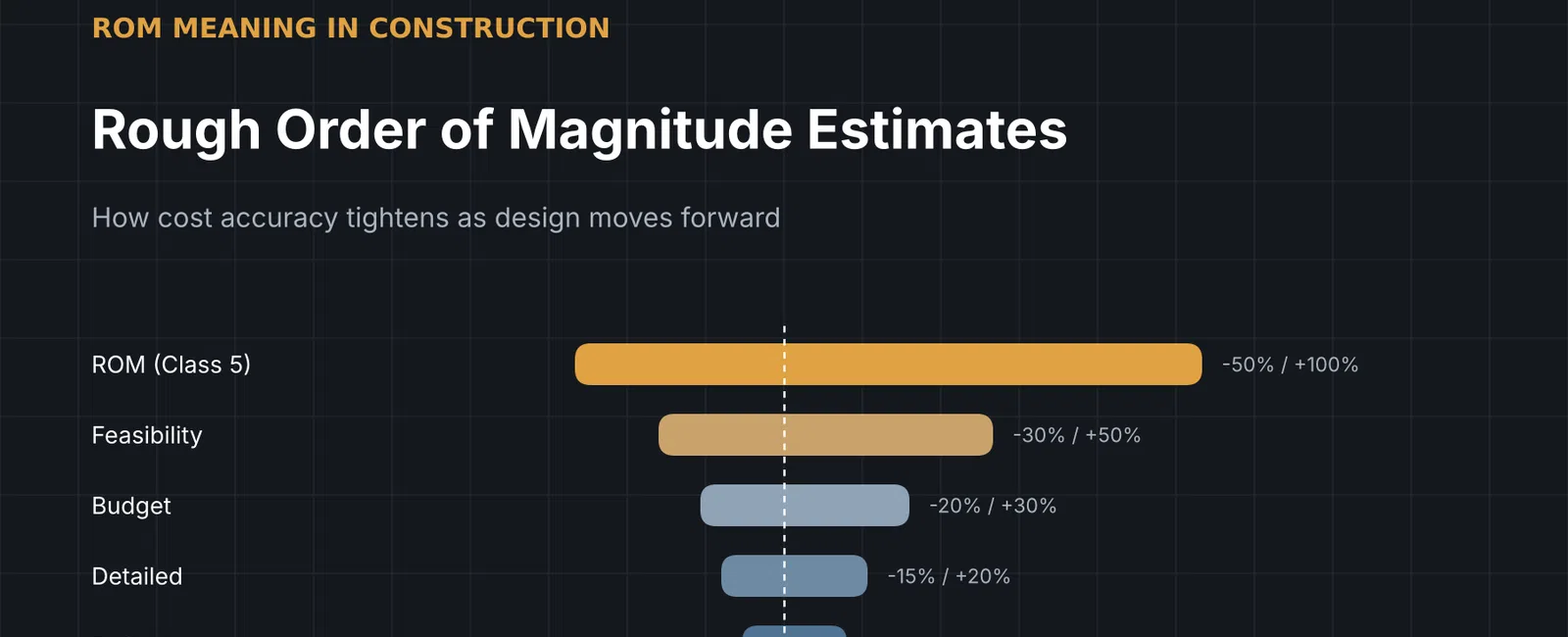
A rough order of magnitude estimate is the least accurate estimate in the construction process, and that is by design. The Project Management Institute commonly describes ROM accuracy as roughly negative 25 percent to positive 75 percent. AACE International, the professional organization for cost engineering, classifies early concept screening estimates as Class 5 estimates, prepared when only about 0 to 2 percent of the project is defined, with expected accuracy that can range from 20 to 50 percent low to 30 to 100 percent high depending on project type and complexity.
Notice the range is lopsided. Early estimates tend to miss on the low side because unknowns almost always add cost. Site conditions, utility upgrades, code requirements, and owner preferences rarely make a building cheaper once they come into focus. That is why experienced estimators carry generous contingency at this stage.
How Contractors Build a Rough Order of Magnitude Estimate
A ROM estimate is assembled quickly, often in days, using a few reliable inputs.
Cost Per Square Foot and Cost Per Unit
The most common method multiplies the planned size of the building by a cost per square foot drawn from comparable projects. For hospitality and multifamily work, estimators often use cost per key or cost per unit instead, since room count drives so much of the program.
Historical Project Data
The quality of a ROM depends heavily on the quality of the historical data behind it. A general contractor that has built dozens of similar buildings can adjust for building type, construction method, and finish level with far more confidence than one working from generic published averages. Recent projects matter most, because material prices, labor availability, and tariffs can shift costs noticeably from one year to the next.
Allowances and Contingency
Because so much is unknown, a ROM estimate leans on allowances for major systems and on a design and estimating contingency to cover what nobody can see yet. Good estimators also note what the number excludes, such as land, financing costs, furniture, fixtures, and equipment, or offsite utility extensions.
A Rough Order of Magnitude Estimate Example
Here is a simplified, illustrative example. An owner is considering a 90-room select-service hotel and wants to know whether the project pencils out before hiring an architect for full design.
The contractor reviews recent comparable hotel projects and determines that hard construction costs for similar properties have fallen within a range of roughly $150,000 to $190,000 per key. Multiplying by 90 rooms gives a hard cost range of about $13.5 million to $17.1 million. The estimator then adds a note that soft costs, land, FF&E, and financing are excluded, and flags two risks that could push the number higher: unknown soil conditions and a possible requirement for a turn lane.
That ROM doesn't tell the owner what the hotel will cost. It tells them whether the project is worth the next round of investment in design and due diligence. If their lender and pro forma can only support $11 million in hard costs, they've learned that early, for very little money. Our guide to hard costs vs. soft costs in construction breaks down what typically sits on each side of that line.
When to Use a ROM Estimate (and When Not To)
ROM estimates are valuable at the very front of a project. Owners use them to screen sites, compare a renovation against new construction, decide between two building programs, prepare early conversations with lenders or investors, and set preliminary capital budgets. Franchise developers often use ROM figures to evaluate whether a new location makes financial sense before committing to the full brand prototype process.
A ROM estimate should not be used to sign a construction contract, set a final project budget, or compare bids between contractors. When a ROM becomes "the budget" by accident, every later estimate looks like an overrun, even when the project is tracking exactly as it should.
ROM vs. Other Construction Estimates
Construction cost estimates get progressively more accurate as design advances. Understanding where the ROM sits in that sequence helps owners know what to expect next.
ROM Estimate vs. Budget Estimate
A budget estimate, sometimes called a conceptual or schematic estimate, comes after the design team has developed a basic floor plan, building systems concept, and outline specifications. It uses more measured quantities and fewer assumptions, which narrows the accuracy range considerably.
ROM Estimate vs. Definitive Estimate
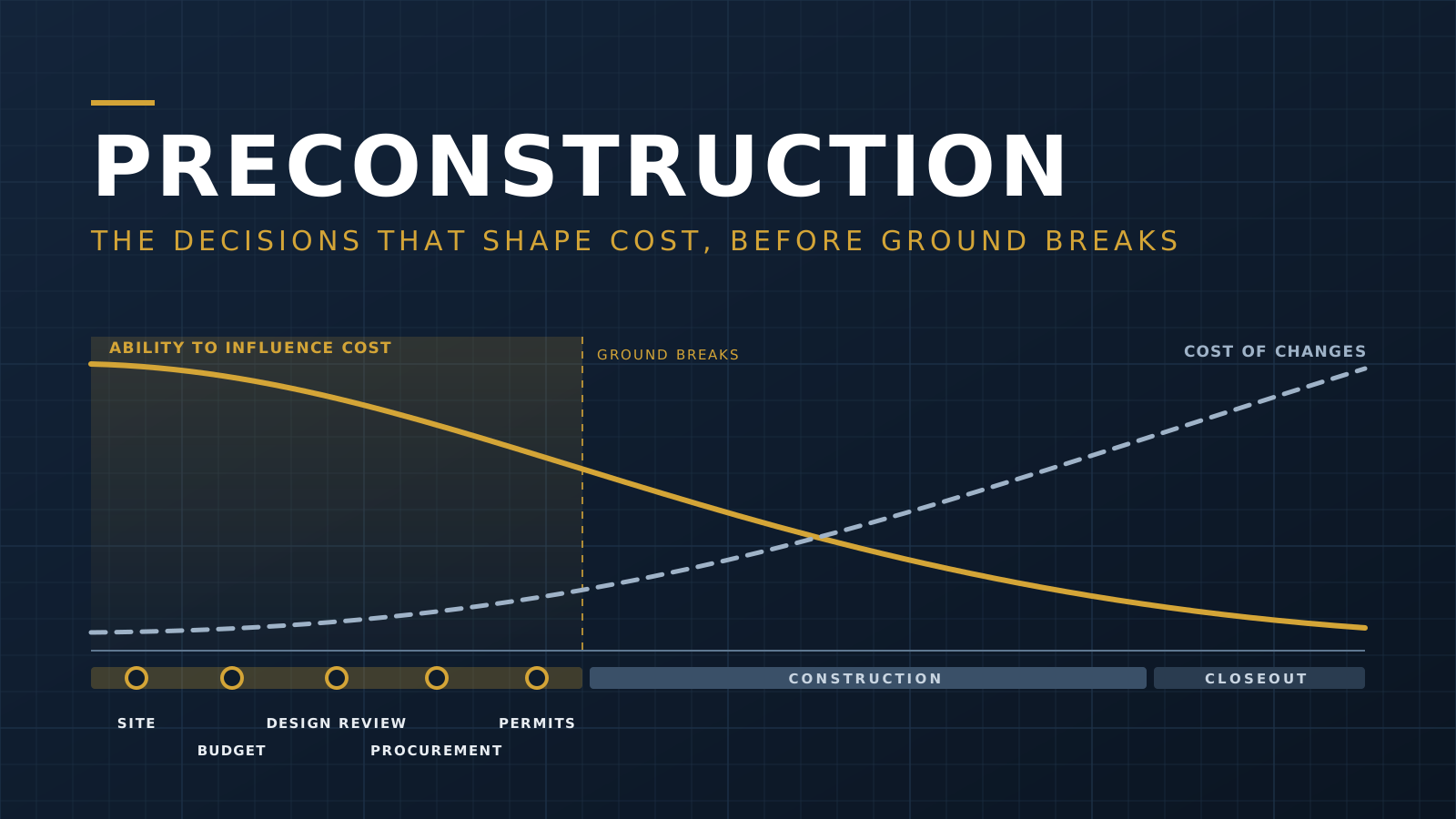
A definitive or detailed estimate is built from construction documents and subcontractor pricing. It is the basis for a lump sum bid or a guaranteed maximum price contract, and it typically carries an accuracy range within about 5 to 15 percent. Moving from a ROM to a definitive estimate is the core work of preconstruction, where the contractor refines pricing at each design milestone.
How Owners Can Get More Value From a ROM Estimate
The best ROM estimates come from a clear, honest conversation at the start. Share everything you know, even if it feels preliminary: target room count or square footage, brand standards, preferred finish level, site address, schedule goals, and any known constraints. The more context the estimator has, the narrower and more useful the range becomes.
Ask the estimator to show the assumptions, exclusions, and largest risks alongside the number. A ROM that says "$4.2 million" with no explanation is far less useful than one that explains a range of $3.8 to $5.1 million, the cost per square foot behind it, and the three unknowns most likely to move it.
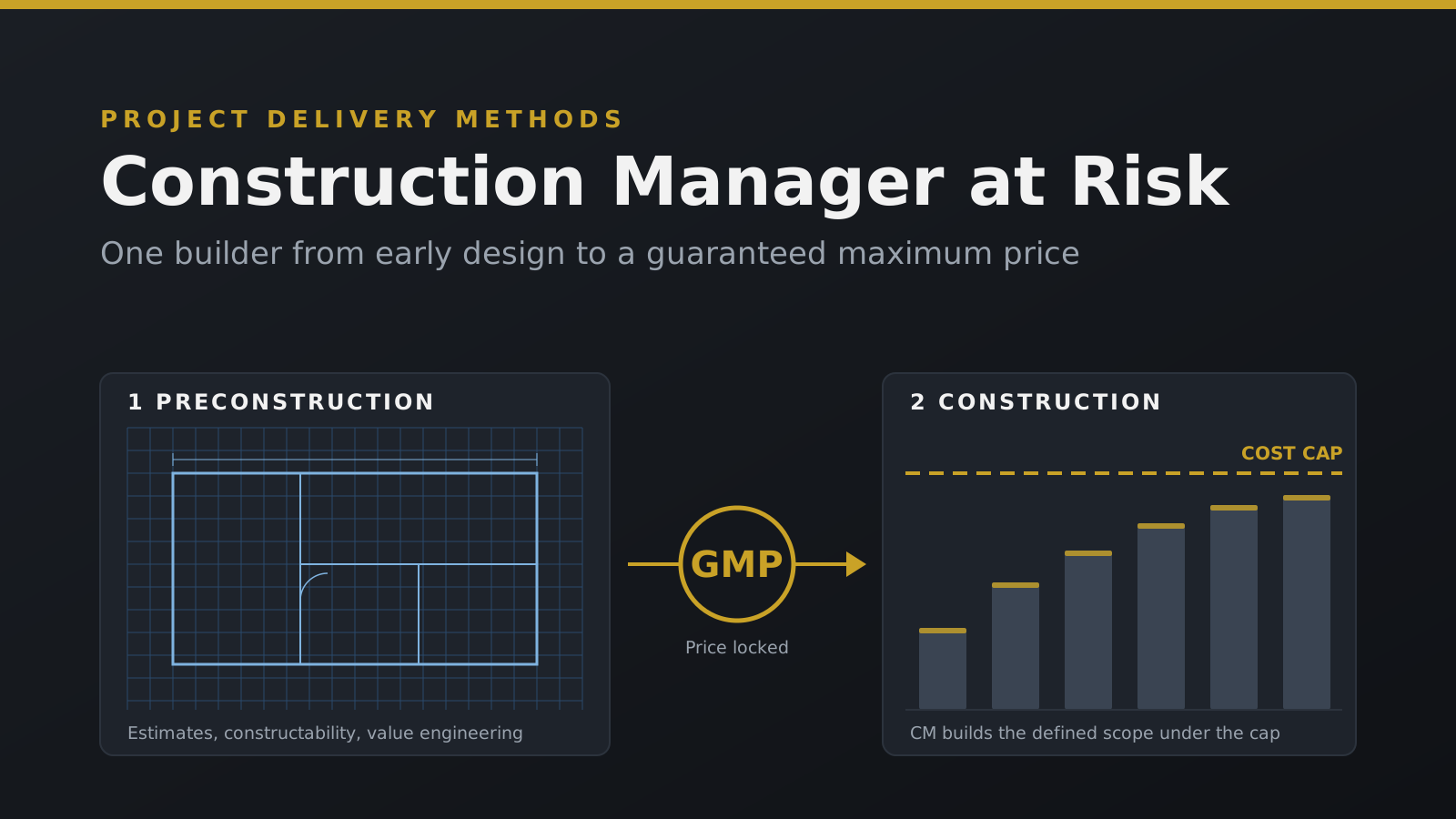
Finally, involve your general contractor early. When a contractor participates from the concept stage, the ROM becomes the first step in a continuous cost conversation rather than a standalone guess. That early involvement opens the door to value engineering before design decisions get expensive to change, and it is one of the biggest advantages of delivery methods like design-build and construction manager at risk.
Turning a ROM Into a Reliable Construction Budget
A rough order of magnitude estimate is a starting point, not a promise. Used correctly, it saves owners from spending months and significant design fees on projects that were never going to fit their budget, and it gives viable projects a realistic financial frame from day one. The key is treating the ROM as the first of several estimates, each one narrowing the range as the design and site conditions come into focus.
At Stonehenge Construction Services, our consultative approach starts with exactly this kind of early cost guidance. Whether you're evaluating a new hotel, a franchise restaurant, or a commercial renovation, we help you understand what your project is likely to cost and what will move that number before you commit. Book a consultation to talk through your project and get a clear picture of where your budget stands.