
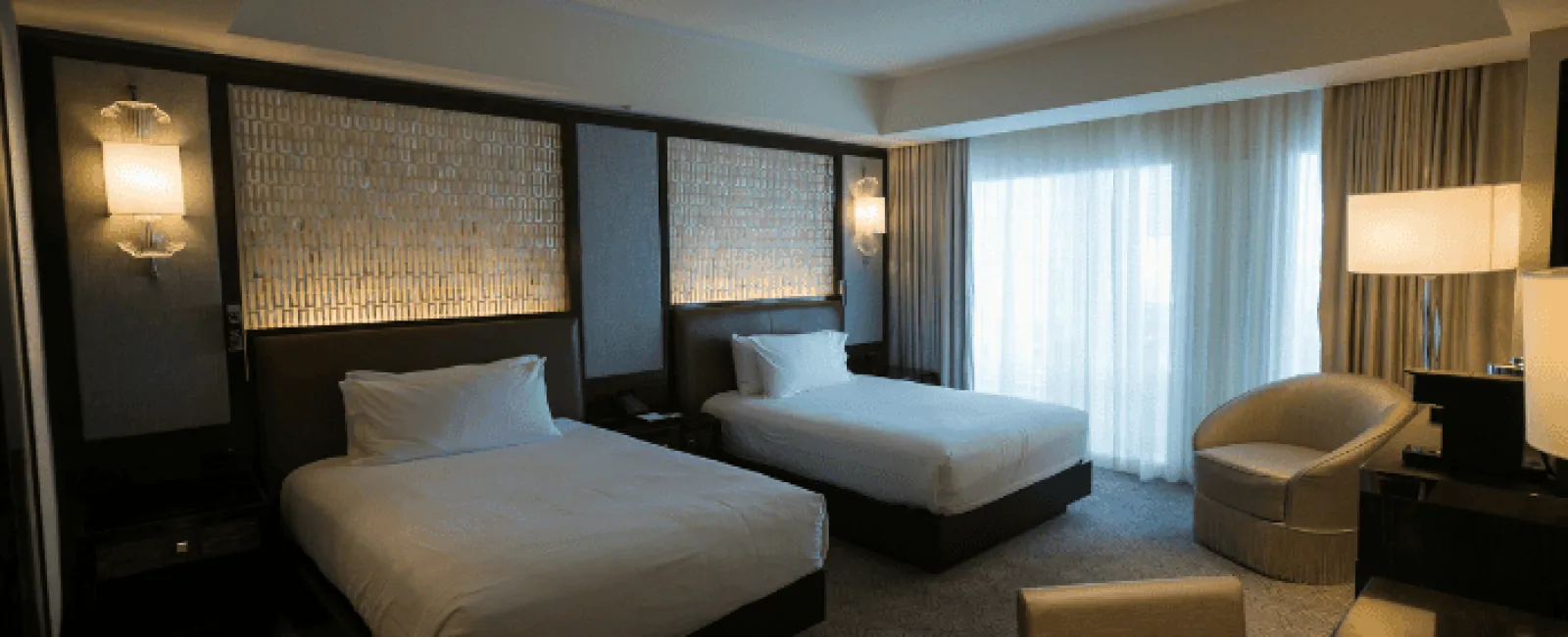
Hospitality construction is the planning, permitting, and physical building of hotels, resorts, and food and beverage spaces operated for paying guests. It covers ground-up new construction of branded hotels (Hampton Inn, Hilton, Marriott, IHG properties, and similar flags), full and partial renovations of existing hotels, brand conversions, and the buildout of restaurant and F&B spaces inside hospitality properties. It is one of the most schedule-sensitive and brand-driven categories of commercial construction, because every project is tied to a franchise agreement, a flag opening date, or revenue lost during a shutdown. The general contractor's job is to execute the work to brand standards while keeping the property operational and the opening on schedule.
What Hospitality Construction Covers
The category includes several distinct types of work that often run in parallel across a single property's lifecycle.
New hotel construction is the ground-up build of a branded hotel on a new site. For developers working with major flags, this means building to a brand prototype: a set of design and construction standards published by the franchisor that dictates room layouts, finish schedules, mechanical specifications, brand-specific signage, and dozens of other elements that must be present at opening. A select-service Hampton Inn or Hilton Garden Inn typically takes 14 to 20 months between groundbreaking and certificate of occupancy. Full-service and dual-brand properties can extend to 24 to 36 months.
Renovation and remodeling work covers small touch-ups, mid-cycle refreshes, and full property repositioning. The largest single driver of hotel renovation activity in the U.S. is the Property Improvement Plan, or PIP, which the franchisor requires when a hotel changes ownership or comes up for franchise renewal. PIPs can run as low as $5,000 per key for a paint-and-carpet refresh or exceed $40,000 per key for a deep renovation on a full-service property. Brand conversions, where a property changes flags between brand families, typically sit at the heavier end of that range and have surged recently as owners reposition assets.
Restaurant and F&B construction inside hospitality properties is its own discipline. The hotel restaurant, lobby bar, or banquet kitchen has all of the operational requirements of a stand-alone restaurant build, plus the constraints of being inside an operating hotel.
Across all three categories, the work spans structural, MEP (mechanical, electrical, plumbing), interior finishes, and FF&E (furniture, fixtures, and equipment) coordination. The FF&E component is unusually large in hospitality compared to other commercial verticals because so much of the guest experience is delivered by movable items rather than the building itself.
New Hotel Construction and Brand Standards
A new hotel is not designed from a blank sheet of paper. The franchisor publishes a prototype, and the architect, engineer, and general contractor reconcile that prototype with the realities of the specific site, jurisdiction, and ownership group.
Brand standards reach deep into the construction scope. Hilton, Marriott, IHG, Choice, and Wyndham each publish detailed design and construction guides that specify corridor widths, door hardware, lighting color temperature, lobby finishes, and equipment lists down to the model number. Approved vendors and finish manufacturers are named. The general contractor's submittals are reviewed by both the local jurisdiction and the brand's design team, and a single substitution that is not pre-approved can stall a project for weeks.
The financial structure of the new hotel work is also distinctive. Hotel construction loans are generally underwritten on a cost per key basis, with limited-service select brands currently building in the $150,000 to $220,000 per key range and full-service hotels often exceeding $400,000 per key, depending on the market and brand. A franchise agreement with a target opening date drives the entire schedule, because a missed opening can trigger penalties, lost royalty income, and tension with the brand's development office. Working with a commercial general contractor who has actually built that brand before compresses the approval cycle and surfaces site conditions that generic contractors miss.
Hotel Renovation and Remodeling
Most hotel construction work in any given year is renovation, not new construction. The reasons are demographic and contractual. The U.S. hotel inventory is mature, and the typical brand franchise agreement requires owners to invest meaningful capital into the asset every five to seven years to maintain brand standing.
The defining constraint on a renovation project is that the hotel usually stays open. Closing a property for six months means losing six months of revenue, displacing repeat customers, and renegotiating group bookings. Owners accept that math only when the renovation scope is too large to phase, which is rare. Far more often, the work is sequenced floor by floor, wing by wing, or by occupancy zone. A 150-room select-service hotel renovating its guestrooms might run six to eight rooms per crew per week, taking floors offline in 30-room blocks while the rest of the property continues to operate.
Phasing around occupied guests has cascading effects on the construction plan. Material deliveries are scheduled outside peak check-in hours. Construction noise is restricted to working hours that do not disturb guests, often 9:00 a.m. to 5:00 p.m. Dust containment is treated as a guest-experience problem, not just a code item. Elevator access is coordinated with housekeeping and maintenance. The crews working hospitality renovations have to be the kind of crews who can keep a job site clean, quiet, and presentable in a way that crews on a typical commercial site do not.
This is where experienced hotel renovation contractors earn their fee. Brand conversions, PIP renovations, and lobby and F&B repositioning all share the same operational reality: the building is generating revenue every day the work is happening, and the owner expects that revenue to continue.
What the Hospitality General Contractor Actually Does
On a hospitality project, the general contractor sits between four parties whose interests do not always align: the ownership group, the management company that operates the hotel, the brand or franchisor, and the design team. Coordinating those parties is at least as much of the job as coordinating the trades.
The GC's responsibilities run across the standard scope of commercial construction management, including preconstruction, scheduling, subcontractor procurement, cost control, safety, and quality control. Several hospitality-specific layers sit on top of that scope.
Brand approval workflow is one of those layers. Major flags require submittal review of finish samples, mock-up rooms, and equipment schedules. Approvals can take three to six weeks per submission, and unapproved substitutions can be rejected at final inspection, forcing rework. Experienced hospitality contractors batch submittals early and maintain direct relationships with the brand's design managers to keep the queue moving.
FF&E coordination is another. As covered in our article on FF&E in construction, hospitality projects typically split FF&E procurement into a separate contract managed by the owner or a purchasing agent, with the GC responsible for receiving, staging, installing, and coordinating around the FF&E delivery schedule. A late shipment, a damaged carton, or a quantity shortage can hold up an entire floor's room turnover and push the opening date.
Hitting the flag opening date is the third layer. The franchise agreement and the marketing calendar are usually built around a specific date. The GC's schedule is reverse-engineered from that date, with the certificate of occupancy, the brand walkthrough, the FF&E install completion, and the staff training period stacked into the final 60 days. Compression at the end of the schedule is normal. Builders without hospitality experience tend to underestimate it.
What Makes Hospitality Construction Different
Several characteristics set hospitality apart from office, retail, or industrial construction.
The first is brand prototype rigor. A typical office tenant fitout is designed around the tenant's preferences. A hotel is designed around a national prototype that the owner agreed to follow when signing the franchise agreement. The general contractor has less flexibility on materials, methods, and substitutions than on almost any other commercial project type.
The second is the FF&E component. On a generic commercial project, FF&E is a small percentage of the total project cost. On a hotel project, it can run 15 to 25 percent of the total budget, and the installation sequence is intricately tied to the construction schedule.
The third is the punch list standard. A guest paying $200 a night for a room expects that room to look new. The acceptable punch list for a hospitality project is far tighter than for a commercial office or retail buildout, and brand walkthroughs hold the GC to that standard before the property is allowed to open.
The fourth is operational continuity during renovation, covered above. Almost no other commercial vertical requires the contractor to keep the building functioning at near-full capacity during the work.
Choosing a Hospitality General Contractor
The factors that matter most when selecting a contractor for hotel work are different from those that matter on office or industrial projects.
Brand-specific experience is the first filter. A contractor who has built a Hilton-family hotel before knows the submittal process, the typical substitution requests that get rejected, and the standard sequencing the brand expects. That pattern recognition saves weeks of approval cycles. At Stonehenge, we have built Hampton Inn properties in the Atlanta market and carry that brand-side experience into every hospitality bid we work on.
Track record on occupied renovations is the second. Ask for projects where the hotel stayed open. Ask about complaint rates, average room turnover days, and how dust and noise were managed. Crews and project managers without that pattern of experience will discover the difficulty mid-project, and so will the hotel's guests.
Coordination capacity with the design team and brand is the third. The contractor should have a documented track record of working directly with brand design managers, FF&E procurement firms, and operating management companies, not just architects and engineers.
Hospitality construction is where brand standards, operating revenue, and construction reality meet. Working with a hospitality contractor who understands all three is what separates a hotel that opens on its flag date and stays open during renovation from one that does not.