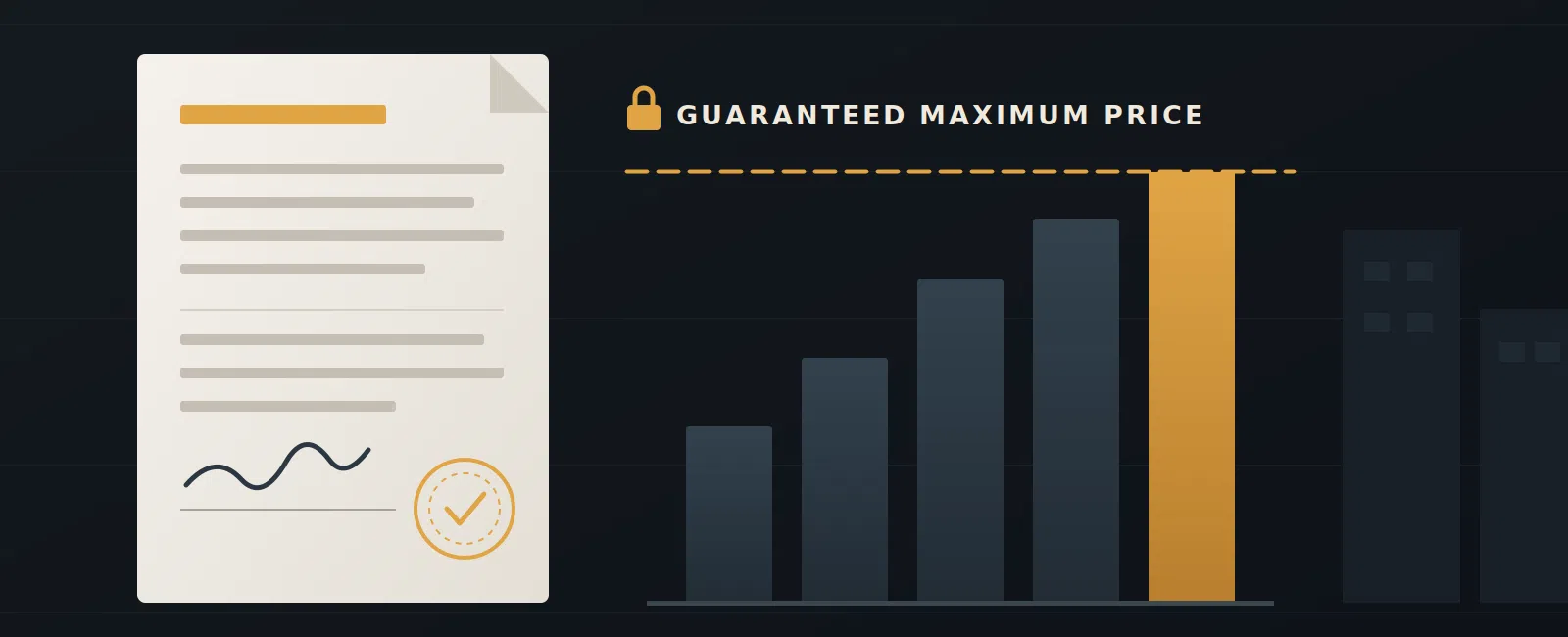
A GMP contract, or guaranteed maximum price contract, is a construction agreement in which the contractor commits to delivering a defined scope of work for no more than an agreed ceiling price and absorbs any cost above that ceiling. The owner reimburses actual, documented project costs plus a negotiated contractor fee, and any unspent funds under the cap are either returned to the owner or split according to a savings formula outlined in the agreement. This structure gives owners a hard budget number before construction begins while still allowing design details to develop. The guarantee applies only to the scope defined at the moment the number is set, which is why the qualifications attached to a GMP matter as much as the figure on the cover page.
How a Guaranteed Maximum Price Contract Works
Under a GMP agreement, the contractor opens the books. Every subcontract, material invoice, labor hour, and general conditions expense flows through to the owner at documented cost, and the contractor earns a separate fee that is usually a fixed dollar amount rather than a percentage of spend. The ceiling sits on top of all of it. If the project finishes at 90% of the guaranteed maximum price, the owner never pays the remaining 10%. If it runs to 110%, the contractor covers the difference.
That makes a GMP contract a cost-plus arrangement with a cap, and reading it that way clears up most of the confusion. It is not a lump sum. In a lump-sum contract, the contractor keeps whatever it does not spend, so the owner gets a firm price but has no visibility and no claim on unused money. In an open cost-plus contract, the owner sees every dollar but has no protection against a rising total. The guaranteed maximum price contract takes the transparency of one and the ceiling of the other.
What the GMP Actually Guarantees
This is where owners get into trouble, and it has almost nothing to do with the price itself. A guaranteed maximum price guarantees a number against a specific set of documents on a specific date. Attached to every legitimate GMP proposal is a page of qualifications, clarifications, and exclusions, and that page is the real contract.
Suppose a hotel GMP is set at 50% of construction documents, which is common for negotiated work. The mechanical design is still developing. The contractor carries an allowance for rooftop units based on the engineer's preliminary tonnage. If the final design lands on larger equipment, that is a scope change; the GMP adjusts upward, and the owner pays. Nothing improper happened. The guarantee never covered a design that did not exist yet.
Owners who read the exclusions page carefully and ask what each allowance is based on rarely get surprised. Owners who read only the cover page frequently do.
Where Contingency Sits in a GMP Contract
Two separate contingencies typically exist within a guaranteed maximum price contract, and they behave very differently.
The construction contingency belongs to the contractor and covers issues that arise within the agreed scope. Examples include unforeseen conditions behind an existing wall, a subcontractor default, or a coordination conflict between trades. The contractor spends it without a change order, though a well-run job reports every draw against it so the owner can watch the balance.
The owner contingency belongs to the owner and covers decisions the owner makes after the number is set. Upgrading a finish, adding a signage package, expanding a scope. It is not the contractor's money and cannot be spent without authorization.
Ask which contingency you are looking at and what percentage it represents. Three to five percent construction contingency on a well-documented project is normal. Ten percent usually signals that the documents are less complete than the proposal implies, and the honest conversation is worth having before signing rather than after.
How Savings Get Shared
If the project finishes under the cap, the leftover money goes somewhere, and the agreement decides where. Common splits run from fifty-fifty to one hundred percent back to the owner, with seventy-five twenty-five in the owner's favor being a reasonable middle ground on commercial work.
The split matters less than the incentive it creates. A contractor with real upside in the savings has a reason to buy the job aggressively, run a tight schedule, and bring value engineering ideas forward during construction rather than sitting on them. A contractor with zero upside has no financial reason to work the buyout hard.
The risk owners should watch for runs in the other direction. A contractor can pad the estimate, set a comfortable ceiling, finish well under it, and collect a share of the savings engineered into the number from the start. The defense is an open buyout. Ask to see the bid tabs for major trades and confirm that there are at least 3 qualified bidders per package. A contractor unwilling to show that is telling you something.
When a GMP Contract Is the Right Choice
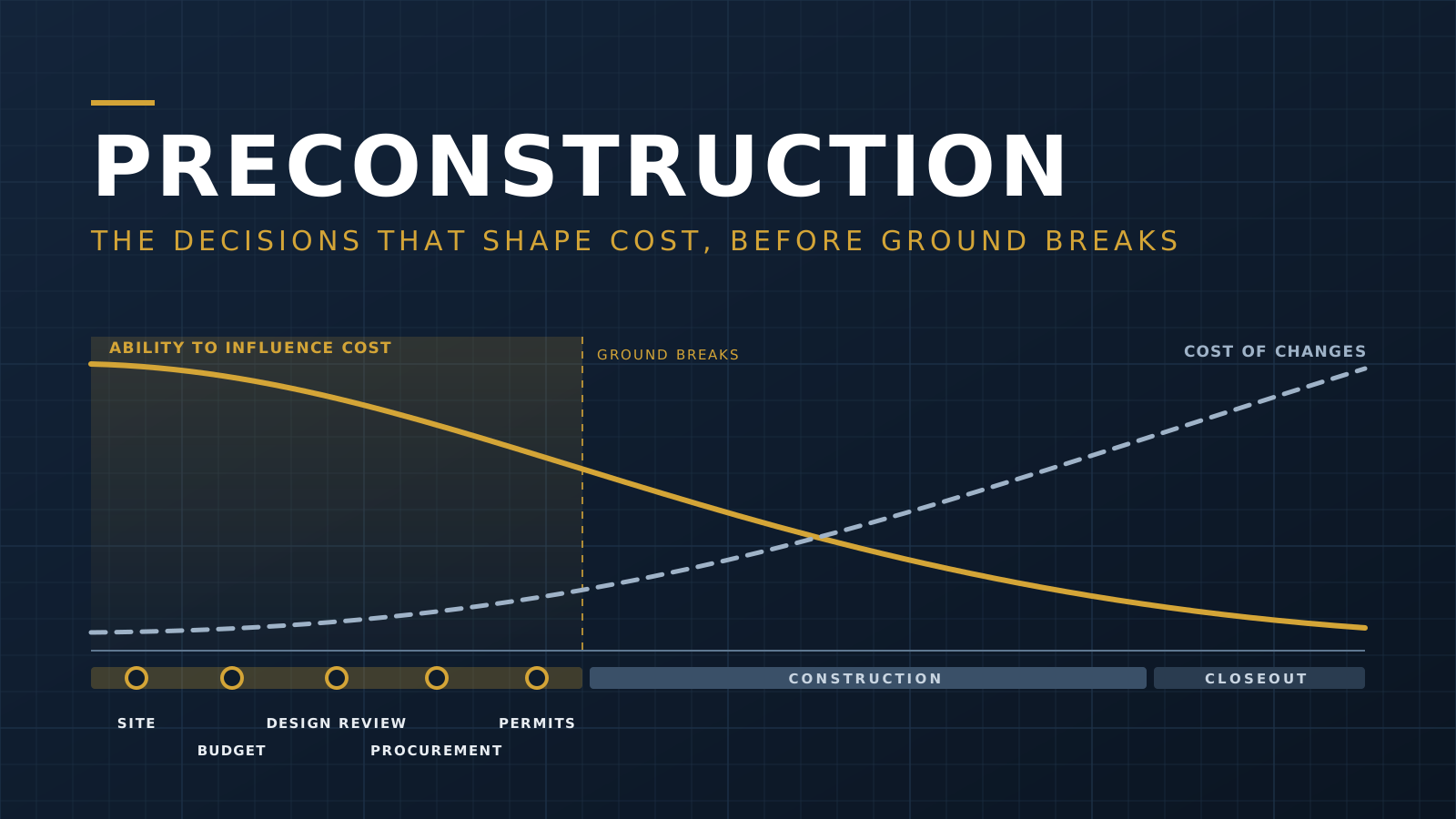
The guaranteed maximum price model fits projects where the owner needs a firm budget commitment before the design is fully resolved, and where the contractor is brought in early enough to influence cost. At the same time, decisions are still cheap to make.
Hotel and Hospitality Projects
Hotel construction and renovation work suits a GMP well because brand standards, franchise approvals, and FF&E selections often finalize after the budget must be locked for financing. A GMP set at a defined document milestone allows the developer to present a firm number to the lender while the interior package continues to develop. Property improvement plan renovations benefit even more, since the existing conditions behind the finishes are genuinely unknown until demolition, and a properly sized construction contingency absorbs what is found.
Franchise and Quick Service Restaurant Development
Franchise and QSR builds are typically well-documented through prototype drawings, making them strong candidates for a tight GMP with a lean contingency. The variables are site-specific rather than design-specific. These include utility connections, sitework, and permit-driven modifications. A contractor with prototype experience for a given brand can precisely qualify those variables rather than bury them in padding, which is the difference between a competitive ceiling and a defensive one.
Institutional and Industrial Projects
Public and institutional owners often require a GMP because it demonstrates budget discipline to a board or funding body while permitting design to progress. Industrial work with heavy equipment coordination benefits from the same early contractor involvement, since equipment lead times and foundation requirements drive both the schedule and the number of units.
Questions to Ask Before Signing a GMP Agreement
Ask what document set the guaranteed maximum price is based on and what percentage complete it is. Ask for the full list of allowances with the basis of each. Ask how many bidders covered each major trade package. Ask how construction contingency draws are reported. Ask how savings are calculated and when they are released. Ask what the fee covers and what falls into general conditions instead.
A contractor who answers all six clearly is running an open book and will keep running one. A contractor who deflects is showing you exactly how the rest of the project will go.
The GMP Is Only as Good as the Preconstruction Behind It
A guaranteed maximum price is not a document. It is the output of a preconstruction process, and its reliability depends entirely on how thoroughly that process was run. Scope normalized across bidders so packages can be compared fairly. Allowances tied to real basis of design rather than round numbers. Long lead items identified and priced before the market moves. Value engineering worked while the design can still absorb it.
Stonehenge Construction Services builds guaranteed maximum price proposals the same way we build the projects behind them, with the qualifications page written to be read and the buyout open to inspection. If you are evaluating a GMP contract for a hotel, franchise, institutional, or industrial project, we are glad to walk through the structure with you before you commit to a number.